KEYNOMEN AVIATIONSign Up →

About Keynomen

The Vast Language of Aviation

Instructors often see this: a student reads the chapter, closes the book, and can't tell you what they just read.

It looks like they're not trying. They are.

What's actually happening is that the language of aviation washed over them, and without the words, terms, and abbreviations fully understood, the concepts never had a chance to stick.

That fog is a language barrier, not a flying barrier — and it's the quiet reason students drop out.

Master the language and the flying gets easier. Fail at the language and the flying stalls before it ever takes off.

Flight students in a ground-school classroom, one looking overwhelmed as the instructor diagrams sectional chart symbols.

Keynomen — How the Name Came About

Every technical field has its own “nomenclature.” Nomenclature is a systematic set of names, terms, or rules used to classify and identify things within a specific field, science, or industry. It establishes a standardized language so that professionals and communities can communicate easily.

The derivation of “nomenclature”: from nomen, the Latin word meaning “name,” and calare, the Latin verb meaning “to call” or “to summon.” A nomenclator was a Roman worker whose specific duty was to remember and call out the names of people — especially guests — to help a host greet them. Nomenclatura was the Latin noun for “a calling of names” or “a list of names.”

A “key” is what unlocks understanding. The word you grasp fully — becomes the key to grasping the subject.

Hence — Key Words or Key Names became KEYNOMEN.

Full Conceptual Understanding

Go around and ask pilots — “What is an Empennage?” You will get answers like “It's the tail section of an airplane, the section with the rudder and elevator.” That would be correct. But why don't we just call it “The Tail Section” then? Why is it called the Empennage? What does that word really mean?

The derivation (or origin) explains it. It comes from the French word penne, which means “feather” (from the Latin penna), and in French empenner, as a verb, means “to feather an arrow” — putting feathers on the back of an arrow so it flies straight and stable. That gets you closer to having a full conceptual understanding, doesn't it?

So the word's derivation is one of several sections in the KEYNOMEN definition structure, each providing a fuller conceptual understanding of the term.

Close-up of hands fletching an arrow — attaching feathers to the shaft.

Words, Terms & Abbreviations — And the Problems with Definitions

There are many ways a word can be misunderstood. The most common in aviation is simply not having a definition at all. The student has no idea what the term means.

To compound the problem, even when the student tries to look it up, they often stumble onto more unfamiliar words inside that definition. That's called a word chain — and it's bad news for studying.

A word chain pulls the student away from what they came to learn. With a paper dictionary or glossary, navigating one quickly gets overwhelming. Some students give up on the term entirely. Others get so far down the chain they forget what they were originally studying.

Word chains are a real obstacle to mastering a technical subject. So Keynomen is built to handle them properly.

A word-chain diagram showing how one aviation term leads to the next: empennage, pitch stability, longitudinal axis, center of gravity, and weight-and-balance.

Keynomen's Key Word Definition Methodology

It's designed to make things easy for the student.

Every technical word inside a definition is a live link to its own term page. When a student hits an unfamiliar word, one tap takes them to it — and once that word is cleared, the breadcrumb trail walks them right back to where they started.

The goal isn't to send students wandering. The goal is to make the detour fast and the return automatic — so the chain costs you almost nothing, and you stay focused on the term you actually came to learn.

Each defined word also has several sections, providing more insight and understanding. The student is given example sentences and invited to make and record more sentences of their own. (Doing so adds to their points — and reinforces understanding.)

At the end of this process, the student clicks “Log as Cleared” — not only confident they know what the term means, but building a valuable logbook of their progress.

A confident student pilot smiling at a tablet, no longer foggy — the words have clicked.

Evidence of Aviation Literacy

Progress is tracked through 12 levels of mastering the aviation language. And while that happens, each logbook entry builds toward the next certificate, providing evidence of the student's aviation literacy. (Something airline recruiters may appreciate in a competitive hiring market.)

Keynomen Aviation Literacy ProgramAviation Literacy CertificateAwarded toJane AviatorFor achieving demonstrated competency inOperational Aviation Language FluencyLevel 6 of 12March 14, 2026Date IssuedDaniel BezdenFounder — Keynomen

Word Lists for Easy Study

Words can be looked up one at a time, or the student can simply select the chapter of the FAA handbook they're about to study — and the technical words for that chapter will be listed in the sequence they come up. Easy — master the words, master the chapter.

A chapter's technical word list displayed on a tablet, ready for study.

Human Engineered, AI Assisted

The structure, the grounding rules, the editorial standards — all human created. It took extensive experience, testing, and system development.

The execution of those instructions was AI assisted. The guardrails against drift were extensive. In fact, the full human instruction set was loaded fresh — each time, every time — ahead of each term getting defined.

That's 25,000 times. Same instructions. Every time.

This entire process was then performed independently by three LLMs. After a human evaluation of each LLM's strengths, the results were combined to deliver the best of each.

Finally, the app is designed with the door open for user feedback — so the product can keep benefiting from human input.

Where It Fits

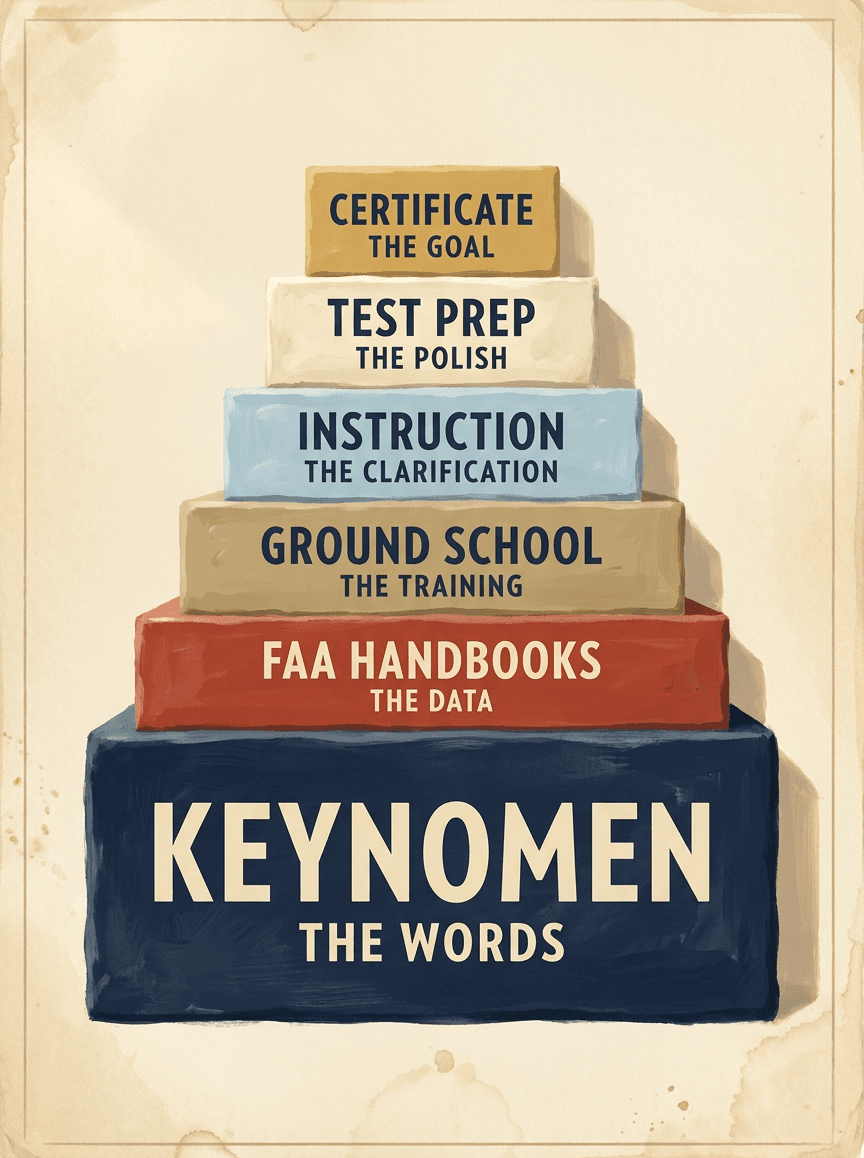
KEYNOMEN provides the underlying foundational support for every other study tool — whether that's Ground School, Online School, Private Instruction, Flash Cards, or Test Prep.

It doesn't attempt to replace any of these tools.

If a student finds they're consistently having trouble with a particular subject area, that's a signal to look for words, terms, or abbreviations they missed — and get them cleared up using KEYNOMEN.

Free to Try

Two free levels are yours to explore — see how Keynomen works, then upgrade to Pro when you're ready.

Master the words, master the language.

Take a look.

From the Founder

Black-and-white portrait of Daniel Bezden, founder of Keynomen.

Hi — I'm Daniel.

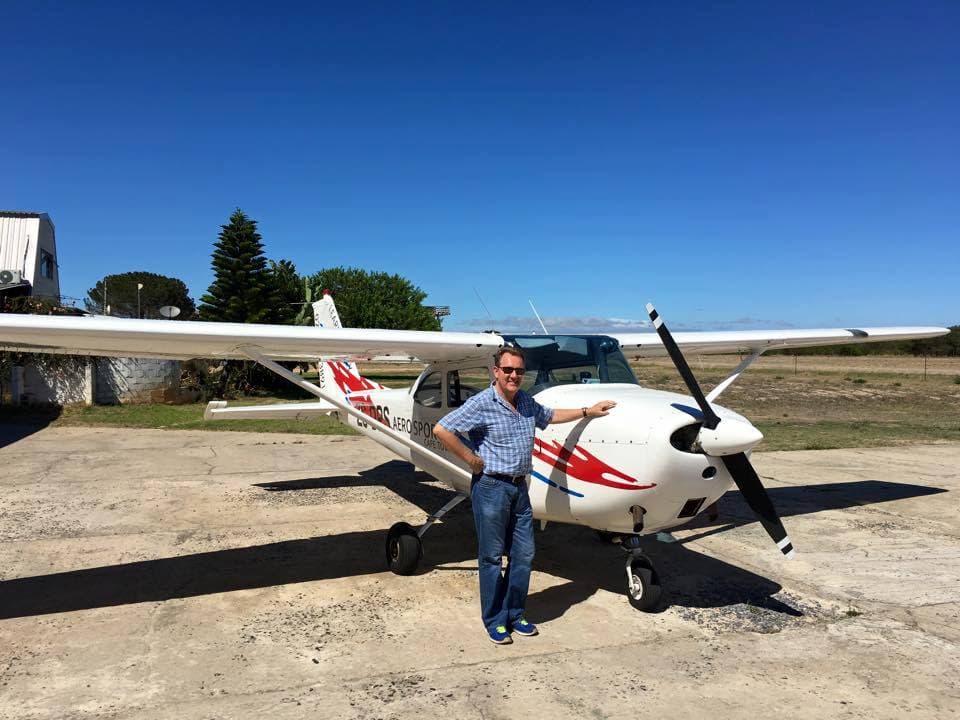
I first obtained my pilot's license at age 17 in South Africa — a country where you get your driver's license at 18. It was definitely “a license to learn.” My confidence in entering controlled airspace left me avoiding it as much as possible. In short, I scraped by with the bare minimum — and as a result, I had fun flying, but could hardly use it as a real business tool.

A wonderful marriage and three kids entered my world. As happens to many young pilots in that situation, I was in my mid 50's when I decided to return to flying and get an FAA license (then living in Austin, Texas). By that time, I also had a real need to use flying as a business tool.

During those interim, non-flying years, I became intimately familiar with the importance of understanding the words of a subject one studies. By the time I decided to return to flying, I knew I really needed to master the written language of aviation.

Attending ground school for six weeks, I saw students sitting around me yawning, looking foggy, and clearly not grasping the subject matter. It became very clear to me why 80% of students dropped out. Although there was some appreciation about the importance of mastering the language, there was no real tool in place to get there. Students just “had to pick it up along the way” — and those who didn't, were thought of as “not having what it takes to become a pilot.” The emphasis was entirely on test prep: “This is what you need to know to pass the FAA written.”

I wanted a grasp on the subject that went beyond the bare minimum. I turned to the available technical dictionaries (of which I now own quite an impressive collection from all over the world). These were painfully difficult to use — most typically because definitions introduced other technical terms, resulting in long word chains, looking up words within the definitions I was clearing. Moreover, definitions lacked derivations. (Why is it called an Empennage?) Practical application notes did not exist.

I'm happy to say I battled through. After getting my FAA license, I often traversed some of the busiest airspace in the world — the D10 TRACON (Dallas–Fort Worth Terminal Radar Approach Control) area — without any hesitation.

I really wanted to solve this problem for fellow pilots, and started working on this challenge several years ago. The costs for doing this were huge. My efforts to attract grants or funding went nowhere. Then AI came along — and it opened the door to getting this done as a self-funded project.

You could ask: “Couldn't users just look up these words using AI tools?” Of course they can. But what they'll soon discover is that the definition quality — and the hassle of having to come up with the correct prompts — is hardly worth the effort. Remove that friction, and you'd have a tool you want to use and love to use. Then there's the added value of having your personal Logbook of Learning and evidence of your Aviation Literacy Level. With all of this put together so efficiently, the cost of a subscription provides excellent value.

So here it is. A tool that will help both pilots and mechanics win as they study this wonderful world of aviation.

I wish you the very best of success and look forward to seeing your feedback as you use this tool on your aviation journey.

Best Regards,

Daniel Bezden
Founder
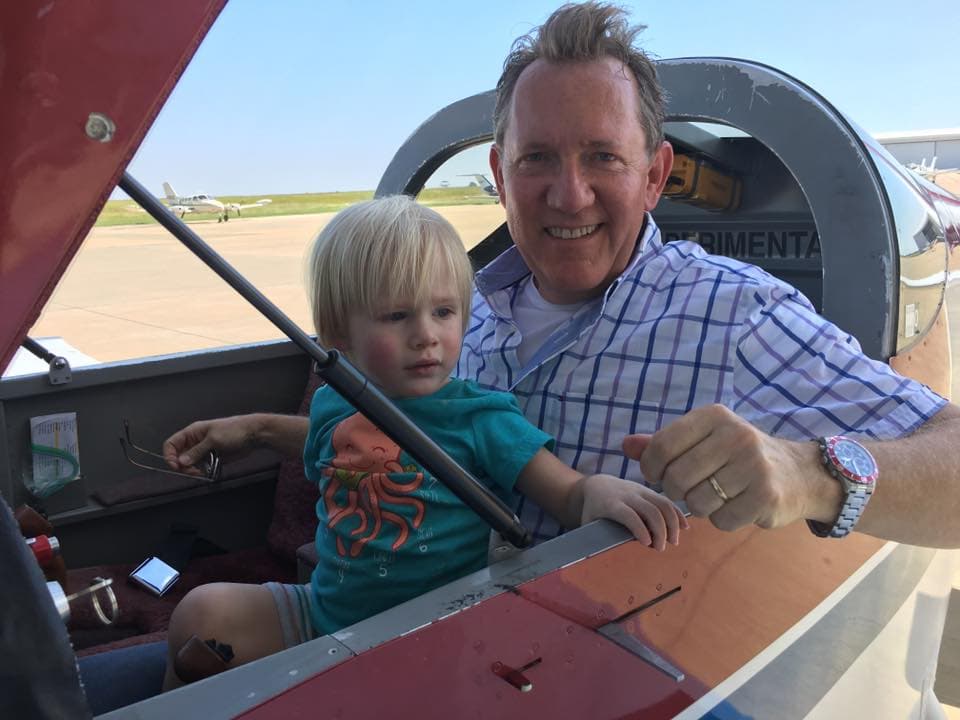
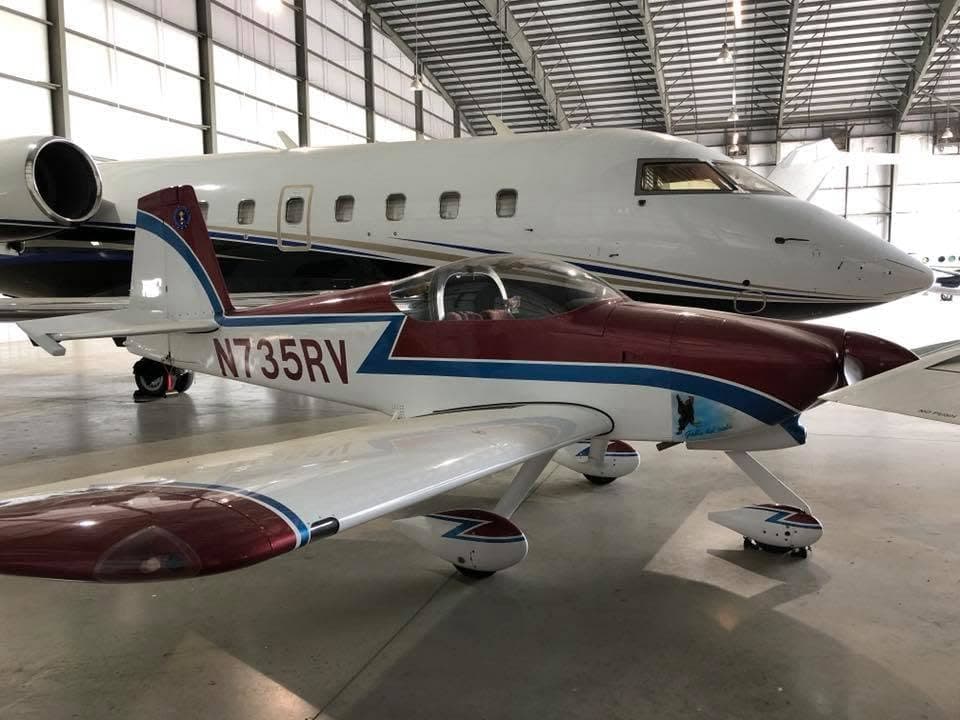
Daniel standing next to a Van's RV aircraft on a sunlit ramp.
Daniel with a group of aviation YouTubers at an event.
Daniel in front of a Cessna 172 in South Africa, where he first earned his pilot's license.