Plain English Meaning
The set of subjects a pilot has to study and understand — like rules, weather, charts, and how the airplane works — before being allowed to fly on their own.
Full Definition
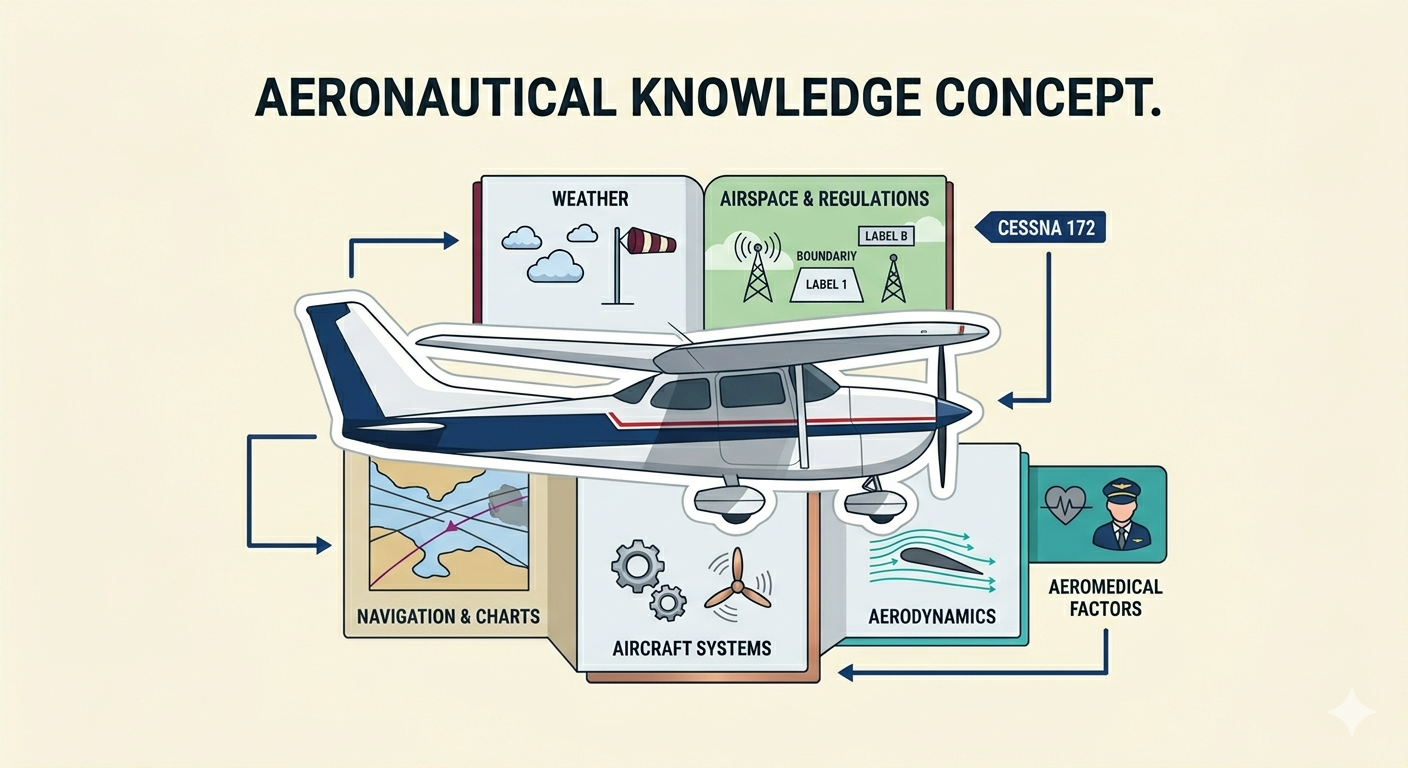
The body of information a pilot is required to learn and demonstrate in order to operate an aircraft safely and legally. It covers areas such as regulations, airspace, weather, navigation, aircraft systems, aerodynamics, performance, weight and balance, flight planning, and aeromedical factors. Aeronautical knowledge is tested through the FAA knowledge (written) test and again orally during the practical test.
Context Anchor
Seen in FAA handbooks, pilot training requirements, written tests, and instructor sign-offs.
Derivation
‘Aeronautical’ comes from the Greek aēr (air) and nautikos (relating to sailing or navigation) — literally ‘navigating the air.’ So aeronautical knowledge is, plainly, ‘knowledge about navigating in the air.’
Why Pilots Care
A pilot cannot obtain any FAA certificate without passing the aeronautical knowledge test that covers the required subjects.
Intuition Check
Aeronautical knowledge does not mean general interest in airplanes. In FAA use, it means the specific flying knowledge a pilot must understand and apply safely.
Example Sentence 1
Before her checkride, she reviewed weather theory and airspace rules to make sure her aeronautical knowledge was solid.
Example Sentence 2
The instructor confirmed the applicant had sufficient aeronautical knowledge to pass the instrument rating written exam.
Media