Plain English Meaning
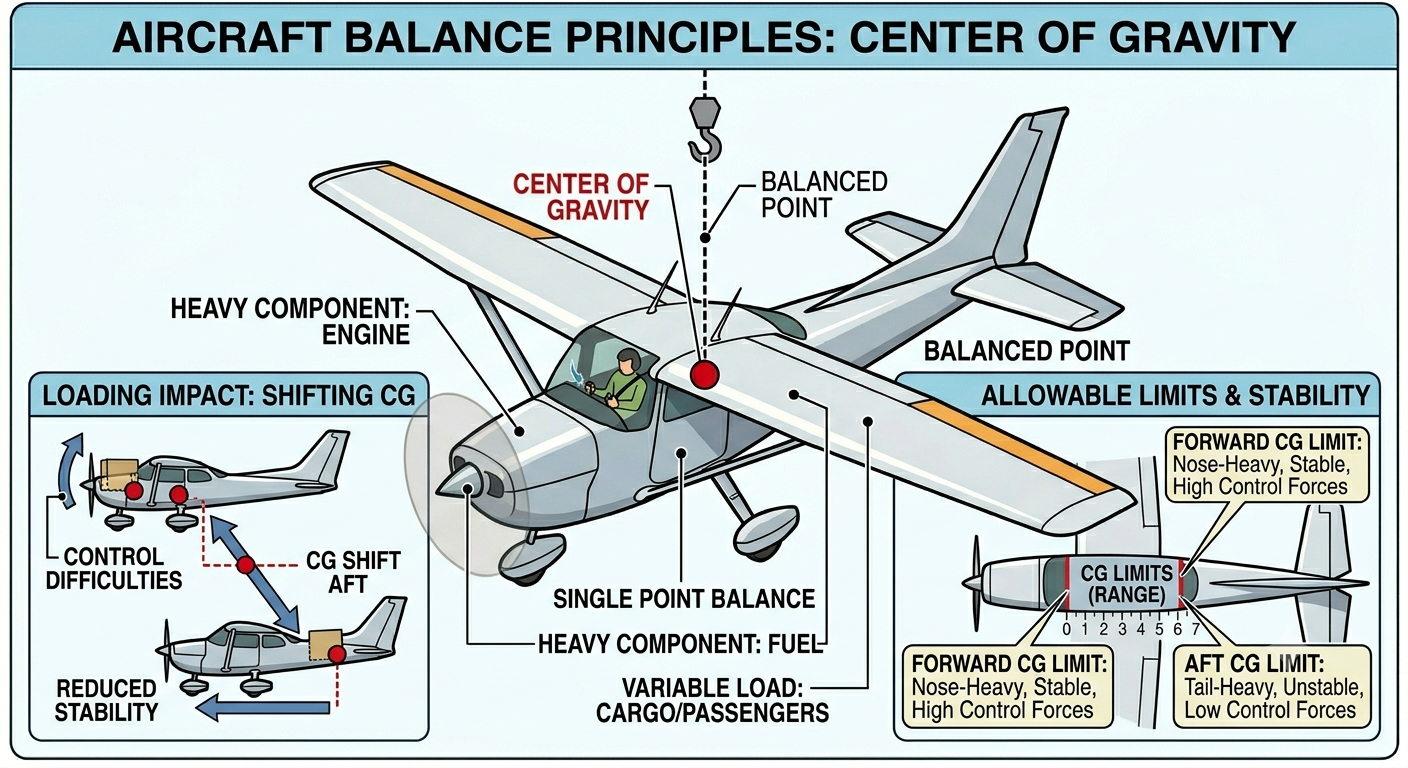
The single balance point of the aircraft. It is the spot where the airplane's weight is effectively centered, and it has to stay within a defined range for the airplane to fly and handle properly.
Full Definition
The point within an aircraft about which all of its weight is considered to be concentrated and balanced. If the aircraft were suspended from this single point, it would balance in any attitude. The location of the center of gravity, expressed as a distance from a reference point called the datum, must remain within limits specified by the manufacturer for the aircraft to be safely controllable.
Context Anchor
Seen in weight-and-balance calculations before flight, especially when loading passengers, baggage, fuel, or cargo.
Derivation
From Latin gravitas, meaning weight or heaviness. The 'center of gravity' is literally the central point of an object's weight.
Why Pilots Care
An out-of-limits center of gravity reduces stability and control effectiveness and can render the aircraft unsafe or unflyable.
Analogy
Think of balancing a ruler on your finger. The point where it sits level without tipping is its center of gravity. An aircraft has the same kind of balance point, just in three dimensions.
Intuition Check
Center of gravity does not mean the physical center of the airplane. It means the balance point of the aircraft’s weight, and that point changes when the loading changes.
Example Sentence 1
Before takeoff, the pilot calculated the loaded weight and confirmed the center of gravity was within the forward and aft limits published in the flight manual.
Example Sentence 2
Shifting heavy cargo forward moved the center of gravity ahead of the allowable range and increased elevator control forces.
Media