Plain English Meaning
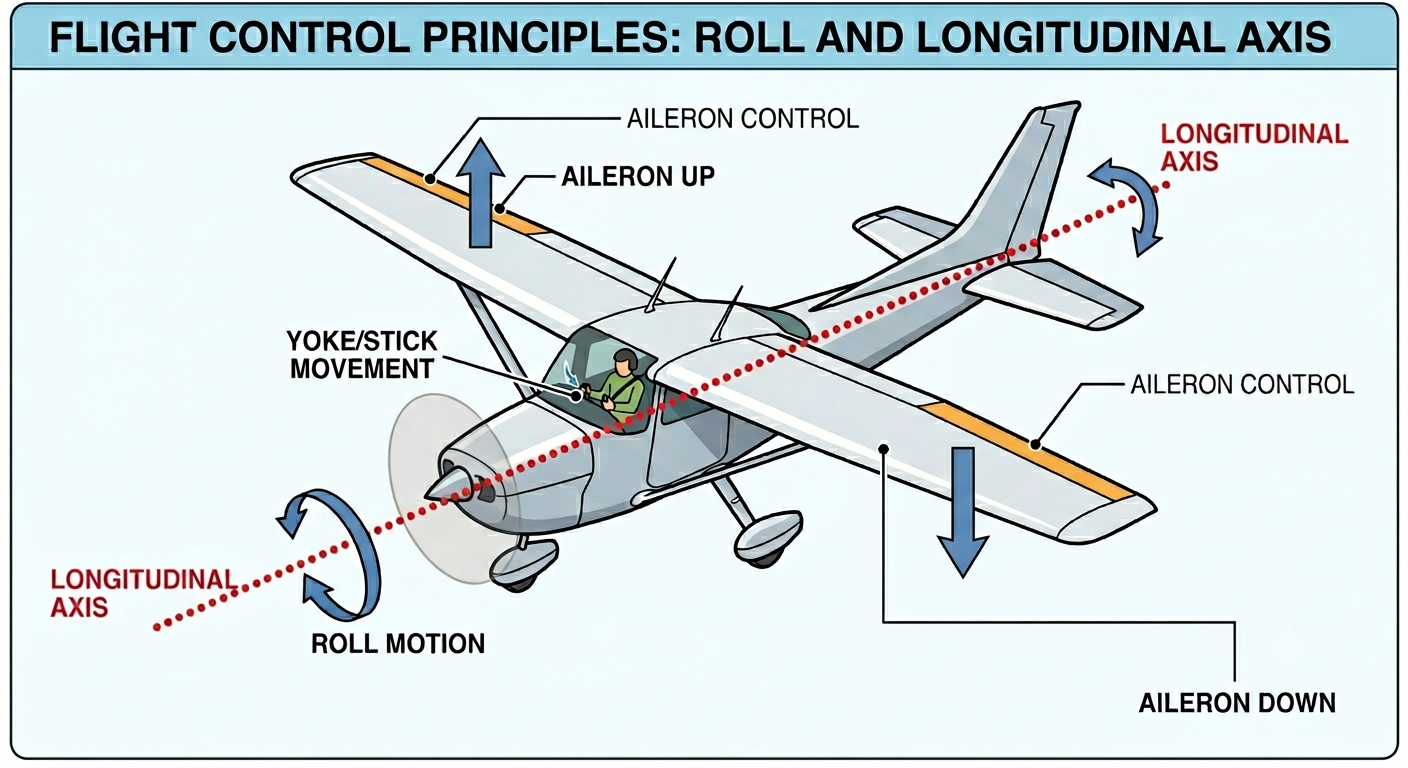
A straight line drawn through the airplane from nose to tail. When the airplane tips one wing down and the other up, it is rotating around this line.
Full Definition
The imaginary straight line that runs through the airplane from nose to tail, passing through the center of gravity. The airplane rotates around this axis when it rolls, which is controlled by the ailerons.
Context Anchor
Seen during before-takeoff control checks and basic flight-control discussions, especially when checking the controls that make the airplane tilt left or right.
Derivation
From Latin 'longitudo' meaning length. The longitudinal axis is the one that runs along the length of the airplane — nose to tail — which is the airplane's longest dimension.
Why Pilots Care
Knowing this axis helps the pilot understand how the elevator changes the nose-up or nose-down attitude of the airplane.
Analogy
Think of a pencil lying on a table. If you roll the pencil, it turns around its own long centerline; an airplane rolling around its longitudinal axis is similar.
Intuition Check
The longitudinal axis is not a physical rod or part installed in the airplane. It is an imaginary nose-to-tail line used to describe how the airplane moves.
Example Sentence 1
When the pilot moves the control wheel left, the airplane rolls around its longitudinal axis, lowering the left wing.
Example Sentence 2
Elevator movement makes the airplane rotate around its longitudinal axis to change pitch.
Media