KEYNOMEN AVIATIONStart Free →
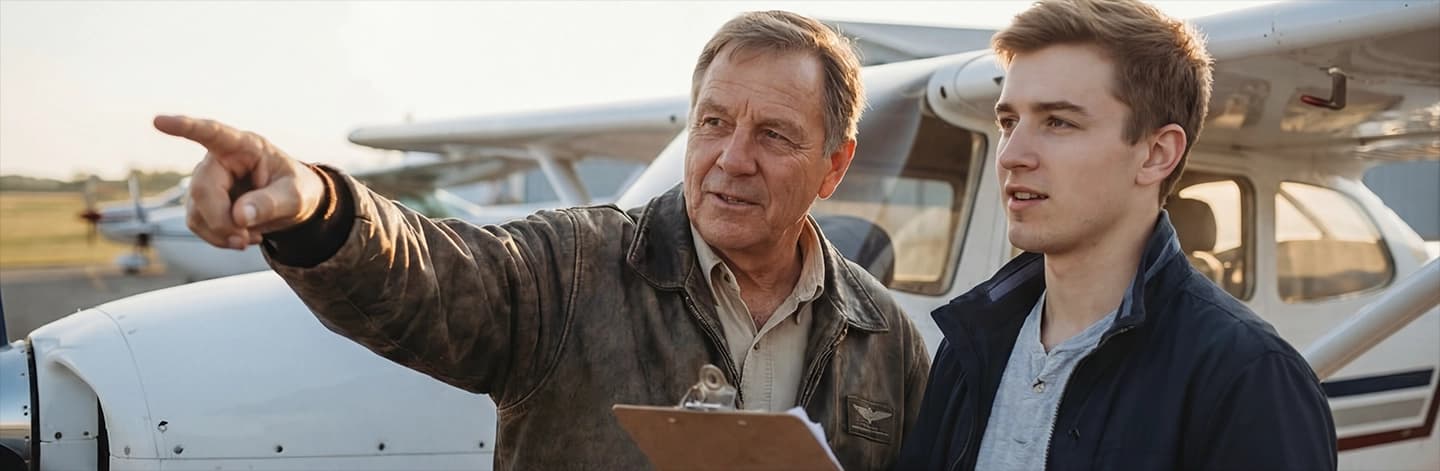
Painting of a flight instructor walking a student pilot out of a hangar onto the ramp, a light aircraft parked on either side of them

Student Pilot
Toolbag

Headset. Kneeboard. Logbook.

And a way to know where you stand.

  • Rate your skills
    as you work through the syllabus.
  • Learn the language of aviation.
    Every term in plain English.

Here’s how you stay on top of things

Takeoffs, Landings & Go-Arounds
8 maneuvers · 174 words
Aircraft
Skills
0
Words
0

Skills - rate how you're doing

  • Normal takeoff and climb
    How this maneuver goes - Airplane Flying Handbook
    1. Line up on centerline, release brakes, advance throttle smoothly to takeoff power.
    2. Use rudder to track straight down the centerline, anticipating the left-turning tendency.
    3. Keep hands light, feet off brakes; let airspeed build.
    4. As controls become effective, apply smooth back-elevator to rotate to the takeoff attitude and lift off.
    5. Hold pitch for Vy, level the wings, stay coordinated on the extended centerline.
    6. With a positive rate confirmed, retract flaps/gear if equipped.
    7. Hold takeoff power to ≥500 ft, then set climb power, trim, and hold Vy.
  • Normal approach and landing
    How this maneuver goes - Airplane Flying Handbook
    1. On base, complete before-landing checklist, reduce power, descend at ~1.4 Vso with drift correction.
    2. Roll onto final, align with centerline, set final flaps, stabilize at ~1.3 Vso, re-trim.
    3. Control descent angle with pitch and power together to track the aiming point — never stretch the glide with elevator alone.
    4. At 10–20 ft, begin the roundout with gradual back-elevator to arrest the descent.
    5. Hold the wheels just off the runway; increase back pressure so the mains touch first at/near stall speed.
    6. Hold back-elevator for aerodynamic braking; lower the nose-wheel as speed decreases.
    7. Maintain directional control; brake smoothly once the nose-wheel is down.
  • Soft-field takeoff and climb
    How this maneuver goes - Airplane Flying Handbook
    1. Set flaps as recommended; taxi onto the surface with continuous motion (never stop).
    2. Apply takeoff power smoothly, holding back-elevator to unload the nose-wheel.
    3. Hold the nose-high attitude so the airplane flies itself off at low speed in ground effect.
    4. After lift-off, gently lower the nose to stay in ground effect and accelerate.
    5. Hold in ground effect until at least Vx (or obstacle-clearance speed).
    6. Climb at Vx to clear obstacles, then lower the nose to Vy.
    7. With positive rate and Vy, retract gear/flaps and set normal climb power.
  • Soft-field approach and landing
    How this maneuver goes - Airplane Flying Handbook
    1. Fly a normal approach at the recommended speed with flaps as recommended; avoid excess speed.
    2. Level off and fly 1–2 ft above the surface in ground effect, carrying some power.
    3. Hold a nose-high attitude; touch down at the lowest possible airspeed with wings still carrying weight.
    4. After the mains touch, hold back-elevator to keep the nose-wheel off.
    5. Use back pressure and power together to control the weight transfer.
    6. Gently lower the nose-wheel, adding a little power to ease it down.
    7. Avoid braking — let the soft surface slow the airplane; keep it moving to avoid getting stuck.
  • Short-field takeoff and maximum performance climb
    How this maneuver goes - Airplane Flying Handbook
    1. Set recommended flaps; taxi to the very beginning of usable runway, aligned.
    2. Hold brakes, apply full power, confirm engine instruments.
    3. Release brakes; accelerate on all wheels in a low-drag attitude.
    4. At Vx, rotate smoothly to the Vx attitude for a positive lift-off.
    5. Hold Vx wings-level until obstacles are cleared (or to ≥50 ft).
    6. Lower pitch to accelerate to Vy; continue climb.
    7. Retract flaps (in increments) and gear, set normal climb power.
  • Short-field approach and landing
    How this maneuver goes - Airplane Flying Handbook
    1. Set up a stabilized final from ≥500 ft with the flap setting before full.
    2. When the field is made, extend full flaps and hold airspeed to keep the aiming point stationary.
    3. Fly to the aiming point at ≤1.3 Vso, adjusting pitch and power together.
    4. Judge the roundout accurately from the steeper angle — minimal float confirms correct speed.
    5. Touch down at minimum controllable airspeed in the power-off-stall attitude.
    6. Hold the positive pitch attitude for aerodynamic braking.
    7. On lowering the nose-wheel, apply maximum braking (stick back) to stop in the shortest safe distance.
  • Power-off 180° accuracy approach and landing
    How this maneuver goes - in the handbook's own words

    When abreast of or opposite the desired landing spot, the throttle is closed and altitude maintained while decelerating to the manufacturer's recommended glide speed or 1.4 VSO. The point at which the throttle is closed is the downwind key position.

    The turn from the downwind leg to the base leg is a uniform turn with a medium or slightly steeper bank. The degree of bank and amount of this initial turn depend upon the glide angle of the airplane and the velocity and direction of the wind. Again, the base leg is positioned as needed for the altitude or wind condition. Position the base leg to conserve or dissipate altitude so as to reach the desired landing spot.

    The turn onto the base leg is made at an altitude high enough and close enough to permit the airplane to glide to what would normally be the base key position in a 90° power-off approach. Initial flaps may be extended prior to the base key position if needed.

    Airplane Flying Handbook, Chapter 9 — Power-Off Accuracy Approaches

  • Go-around / rejected landing
    How this maneuver goes - Airplane Flying Handbook
    1. Recognize the condition and decide without delay.
    2. Apply full/maximum allowable power smoothly (carb heat off as applicable).
    3. Apply forward pressure for a safe pitch attitude against the nose-up tendency; right rudder for torque/P-factor.
    4. Rough-trim once a climb attitude and airspeed are established.
    5. Retract flaps in small increments (to takeoff position), letting the airplane accelerate.
    6. With a positive rate established, retract the gear.
    7. Account for ground effect on a low go-around — don't try to climb out prematurely.

You’re training single-engine.

Words for this area

0 of 174 words cleared · Display less

▾ Show All▾ Expand AllShowing 3 of 21 areas

Are you a CFI?

Verified instructors get free Pro access. Help your students arrive at ground sessions prepared.

Learn about the CFI program →

A flight instructor on the ramp pointing something out to a student pilot beside a parked aircraft.