KEYNOMEN AVIATIONStart Free →
Painting of a flight instructor walking a student pilot out of a hangar onto the ramp, a light aircraft parked on either side of them

Student Pilot
Toolbag

Headset. Kneeboard. Logbook.

And a way to know where you stand.

  • Rate your skills
    as you work through the syllabus.
  • Learn the language of aviation.
    Every term in plain English.

Here’s how you stay on top of things

Private PilotInstrument RatingSoonCommercialSoon
Navigation
4 maneuvers
Cross-Country
Skills
0

Skills - rate how you're doing

  • Pilotage & dead reckoning
    How this maneuver goes - Airplane Flying Handbook
    1. Note the time overhead the departure point and start timing to the first checkpoint.
    2. Fly the precomputed heading and hold it steady rather than chasing the ground.
    3. Look ahead and positively identify the next prominent checkpoint by its surrounding features.
    4. At each checkpoint, note the time, compare to your estimate, and recompute groundspeed.
    5. Compare track to the course line; if drifted, turn to re-intercept and add a wind-correction angle.
    6. Revise ETE and fuel remaining for the next leg using the new groundspeed.
    7. If a checkpoint is missed, hold heading and look for the next one — don't turn to search.
  • Navigation systems (VOR / GPS)
    How this maneuver goes - Airplane Flying Handbook
    1. Tune the VOR to the selected station's frequency.
    2. Identify the station by its Morse/voice ident before relying on it.
    3. Rotate the OBS until the CDI centers with a TO indication; turn to that heading.
    4. Hold heading, keep the needle centered, add a wind-correction angle (turn toward the needle to re-intercept).
    5. Watch for needle fluctuation and a TO→FROM flip to confirm station passage.
    6. For GPS, select Direct-To the destination/fix and fly the magenta course line. `[verify GPS unit procedures]`
    7. Monitor GPS distance/ETE/cross-track and cross-check against pilotage or VOR — never rely on one system.
  • Diversion
    How this maneuver goes - Airplane Flying Handbook
    1. Recognize the need to divert (weather, malfunction, fuel) and pick the best nearby airport.
    2. Turn promptly toward the alternate — in an emergency, divert first and compute en route.
    3. If time allows, start the turn over a prominent ground feature for a known starting point.
    4. Estimate the magnetic course using a nearby VOR compass rose or a paralleling airway.
    5. Note the time; use winds aloft to calculate a heading and groundspeed.
    6. Work out arrival time and fuel required; confirm adequate fuel plus reserve.
    7. Choose a diversion altitude for terrain, clouds, wind, and reception — and fly the airplane first.
  • Lost procedures
    How this maneuver goes - Airplane Flying Handbook
    1. **Climb** — to a safe altitude (traffic/weather permitting) to extend radio, nav, and radar range.
    2. **Communicate** — call any facility shown on the sectional, or 121.5 if needed.
    3. **Confess** — tell ATC you're unsure of position; request vectors or a DF steer; squawk 7700 if an emergency.
    4. **Comply** — follow the vectors and instructions given.
    5. **Conserve** — set economical power to conserve fuel and extend your options.
    6. Fix your position — use VOR/GPS to locate yourself and the nearest airport (read a town name off a water tower if low).

This area is about doing, not vocabulary - its words live in the ground areas.

Are you a CFI?

Verified instructors get free Pro access. Help your students arrive at ground sessions prepared.
Learn about the CFI program →

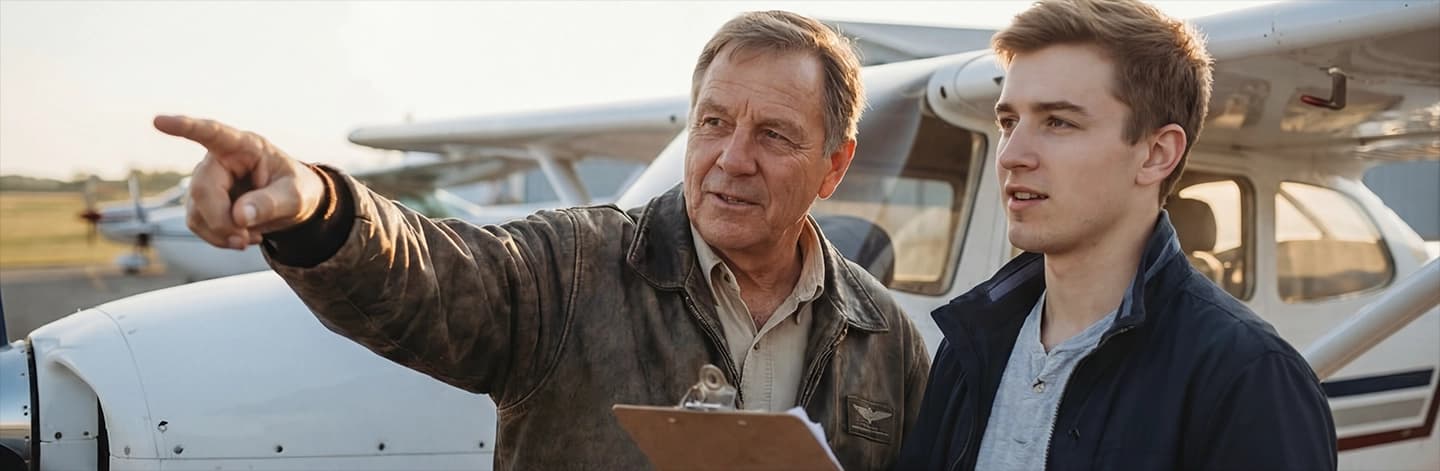
A flight instructor on the ramp pointing something out to a student pilot beside a parked aircraft.