Plain English Meaning
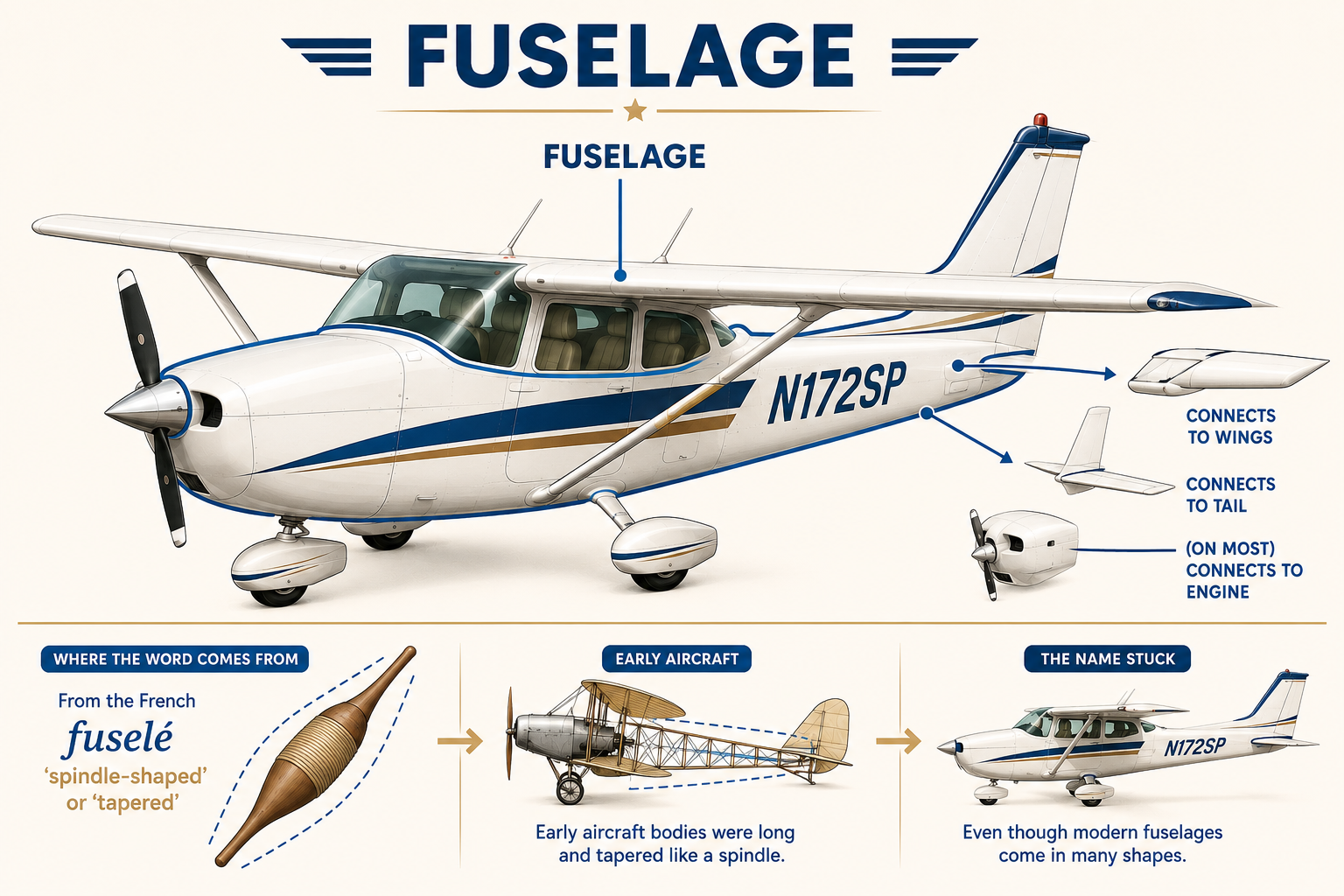
The main body of the airplane — the long tube-shaped part that holds the people and connects to the wings and tail.
Full Definition
The central body structure of an airplane that houses the cockpit, passengers, cargo, and most systems, and to which the wings, tail surfaces, and (on most single-engine designs) the engine are attached.
Context Anchor
Seen during preflight inspection when checking the aircraft body, doors, skin, panels, and attachment areas.
Derivation
From the French fuselé, meaning 'spindle-shaped' or 'tapered.' Early aircraft bodies were long and tapered like a spindle, and the name stuck even though modern fuselages come in many shapes.
Why Pilots Care
The fuselage provides structural integrity, carries the payload, and protects occupants; damage here directly affects safety and flight performance.
Intuition Check
The fuselage is not the whole airplane. It is the main body of the airplane; the wings, tail, and other parts attach to it.
Example Sentence 1
While walking around the airplane, the pilot ran a hand along the fuselage to check for dents or loose fasteners.
Example Sentence 2
The fuselage design determines how much cargo and how many passengers the aircraft can carry safely.
Media